Film, TV and the Arts

Film, TV and the Arts

Saturday, 5 January 2013

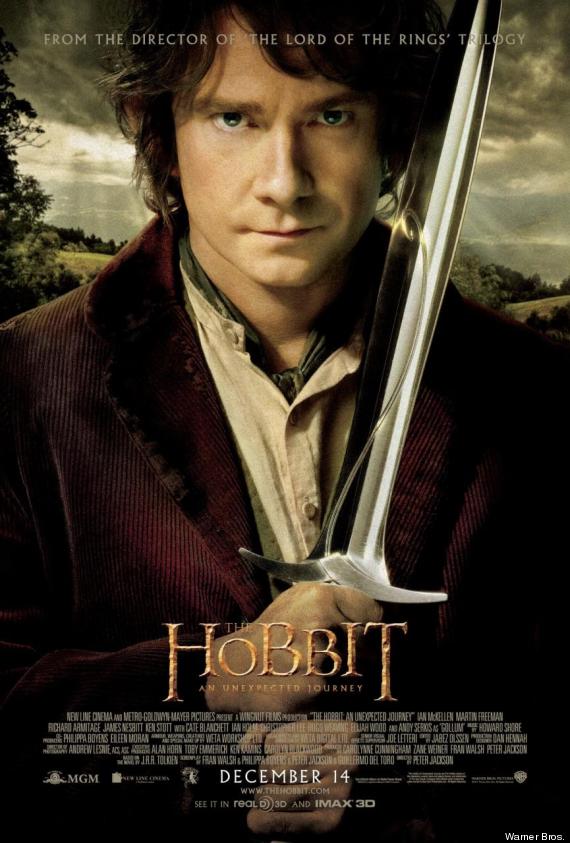
Concerning HFR

What is the deal with 48 fps?


As a child, did you ever have a storytime when you listened to lots of essential but frankly quite dull background detail, and then just as things seemed to have got going and your imagination had lost itself in the world of the story, your mother told you it was bedtime. That rather represents my feelings about The Hobbit: An Unexpected Journey. I have now seen it three times, and with each viewing the fatigue at the exposition and delay of getting into the plot has increased, but so has the genuine sense that the whole trilogy kicks into life in the second half of this first film, and I cannot wait for part two.

Part two contains many exciting mysteries, but we have already had the big technological reveal of High Frame Rate (HFR). The decision to shoot these films at 48 frames per second was taken in order to improve the 3D experience. I first saw this film in IMAX which (bar a few exceptions) is projected at 24 frames per second (fps), and the usual 3D problems were there. There is often a blurring that takes place in 3D which is immensely distracting. Furthermore, the process of 3D removes a third of the colour.

What 48 fps does is give the eye more detail to take in, and this serves to cut out the blurring, and the nature of projecting the increased number of frames improves (though does not eliminate) the colour loss. Both of these were evident improvements in the HFR projection of The Hobbit.
Thursday, 13 December 2012

Review: The Hobbit - An Unexpected Journey


No masterpiece, but there is much to enjoy in this return to Middle Earth

It is the case that Peter Jackson’s Lord of the Rings trilogy is to my generation what the original Star Wars trilogy was to the children of the 70s and 80s. Every Christmas for three years, those films were amazing and formative experiences, showing our young eyes what cinema was capable of. They have swiftly become almost untouchable. I have never fully trusted anyone who has said that they don’t really get The Lord of the Rings. They seem like tricksy Hobbitses.

The LOTR/Star Wars analogy is most apt, because both generations craved more and both generations have had their moment of truth. With the Star Wars generation, it was a case of be careful what you wish for, and the fear amongst Tolkien fans, who learnt from this travesty, is palpable. After all, a slim volume has been transformed into not one, not two, but three films, and we are terrified that we are not about to be transported back to Middle Earth but rather to an accountant’s spreadsheet.

Of course, in such situations, the fanboy is his own worst enemy. He lets his expectations rocket high into the stratosphere, preventing himself from having the relaxed open-mind which let him fall in love with the material in the first place. Given that, the usual reaction to such big releases is torn between cries of “It’s a masterpiece!” and “It’s an abomination!”

In the case of The Hobbit: An Unexpected Journey, it is neither of the two. It is a fine addition to the cinematic Tolkien saga, but it has its problems. These problems are not insuperable, and when the initial furore has died down, it will be evident that Jackson should have our faith that he can really hit top gear with instalments two and three.

Tuesday, 18 September 2012

New Huffington Post piece

A new piece for The Huffington Post entitled: The Brave People of Disney

Tuesday, 14 August 2012

Reel 6 and The Huffington Post

I am very excited to announce that I am now blogging for The Huffington Post UK. The first article, on The Amazing Spider-Man, The Bourne Legacy and others, "Giving it the Reboot" is up and available to read here.

The Reel 6 blog will continue to work away here with reviews, looks at trailers and other posts.

Friday, 20 July 2012

Review: The Dark Knight Rises


The Dark Knight Rises, if not to new heights, then to a thrilling finale


The Dark Knight is risen. He is risen indeed. Christopher Nolan’s third Batman film promised to be an epic conclusion to The Dark Knight saga, and it is truly epic in ambition, scale and action. Though there is no use in claiming that The Dark Knight Rises is perfect, for those who are fanatical about the films it should be an incredibly satisfying end to the trilogy.

We return to Gotham eight years since The Dark Knight. The streets have been cleaned up with the help of the heroic example of the myth of Harvey Dent. Bruce Wayne has become a recluse and Batman is no longer required. All seems well. However, a new villain is on the horizon in the form of the masked man-mountain, Bane. His intentions are unclear. All that is apparent is that he should be feared. As dangers mount, will Batman return?

Thursday, 19 July 2012

Profile: Christopher Nolan

Ahead of the release of The Dark Knight Rises, Reel 6 re-evaluates the career of one of the world's most talented filmmakers

There have been few directors as obviously talented as Christopher Nolan. The simple fact is that he has never made a bad film. His least good film is Insomnia, and that is a very watchable, solidly put together thriller: not poor by any means. The man has the consistency of a metronome.

Yet, it is fascinating to look at how this filmmaker has developed. The former English Lit. student at UCL never went to film school, and has described himself as learning by going out and making films. Certainly, this is borne out by how his movies have developed and improved.

Thursday, 7 June 2012

Lost in Translation?


A few thoughts on the cons (and pros) of English language remakes


“English. English. English is best. I wouldn’t give tuppence for all of the rest.” So goes the logic of the Hollywood executive it seems, as they continue to commission English language remakes of foreign films. It is rightly assumed that executives are pro these remakes because of their seemingly predictable financial success. The idea has already found an audience and is now being translated into English for a wider, western audience.

The figures do not back this up however. The most common rehashes are of oriental horror films such as The Ring, The Grudge and Dark Water. Some of these do achieve huge financial success in their English forms (The Ring), but many do averagely or worse (Dark Water was a big flop).

However, whilst the misguided accountant has clear (if wrong) reasons for wanting to remake the films, the filmmaker’s motives are often more questionable. Why remake a film unless you wanted to do something new with it?